
HOMESICK
FOR A DICTATORSHIP
Majority
of Eastern Germans Feel Life Better under Communism
by
Julia Bonstein, 07 July, 2009
|
|
HOMESICK
FOR A DICTATORSHIP |
|
Majority
of Eastern Germans Feel Life Better under Communism |
|
by
Julia Bonstein, 07 July, 2009 |
|
| Glorification of the German Democratic Republic is on the rise two decades after the Berlin Wall fell. Young people and the better off are among those rebuffing criticism of East Germany as an "illegitimate state." In a new poll, more than half of former eastern Germans defend the GDR. |
| The life of Birger, a native of the state of Mecklenburg-West Pomerania in northeastern Germany, could read as an all-German success story. The Berlin Wall came down when he was 10. After graduating from high school, he studied economics and business administration in Hamburg, lived in India and South Africa, and eventually got a job with a company in the western German city of Duisburg. Today Birger, 30, is planning a sailing trip in the Mediterranean. He isn't using his real name for this story, because he doesn't want it to be associated with the former East Germany, which he sees as "a label with negative connotations." |
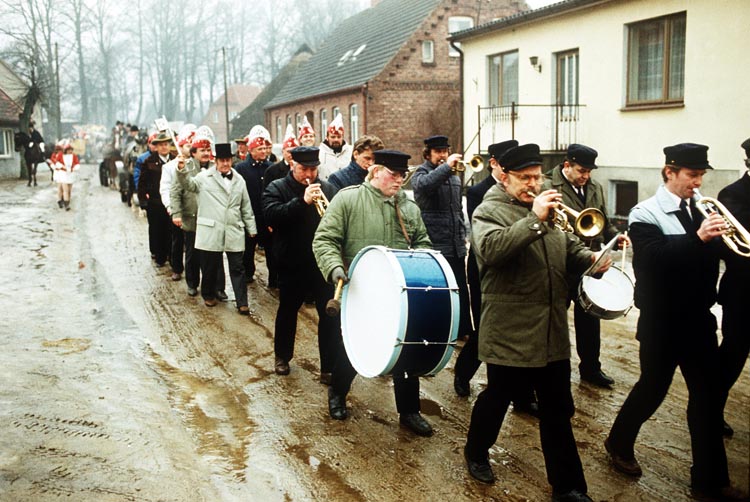
| PHOTO GALLERY: GDR REMEMBERED |
 |
 |
%20has%20taken%20shape,%20says%20historian%20Stefan%20Wolle.jpg) |
And
yet Birger is sitting in a Hamburg cafe, defending the former communist
country. "Most East German citizens had a nice life," he says.
"I certainly don't think that it's better here." By "here,"
he means reunified Germany, which he subjects to questionable comparisons.
"In the past there was the Stasi, and today (German Interior Minister
Wolfgang) Schäuble -- or the GEZ (the fee collection center of Germany's
public broadcasting institutions) -- are collecting information about
us." In Birger's opinion, there is no fundamental difference between
dictatorship and freedom. "The people who live on the poverty line
today also lack the freedom to travel." |
| Birger is by no means an uneducated young man. He is aware of the spying and repression that went on in the former East Germany, and, as he says, it was "not a good thing that people couldn't leave the country and many were oppressed." He is no fan of what he characterizes as contemptible nostalgia for the former East Germany. "I haven't erected a shrine to Spreewald pickles in my house," he says, referring to a snack that was part of a the East German identity. Nevertheless, he is quick to argue with those who would criticize the place his parents called home: "You can't say that the GDR was an illegitimate state, and that everything is fine today." |
| As an apologist for the former East German dictatorship, the young Mecklenburg native shares a majority view of people from eastern Germany. Today, 20 years after the fall of the Berlin Wall, 57 percent, or an absolute majority, of eastern Germans defend the former East Germany. "The GDR had more good sides than bad sides. There were some problems, but life was good there," say 49 percent of those polled. Eight percent of eastern Germans flatly oppose all criticism of their former home and agree with the statement: "The GDR had, for the most part, good sides. Life there was happier and better than in reunified Germany today." |
| These poll results, released last Friday in Berlin, reveal that glorification of the former East Germany has reached the center of society. Today, it is no longer merely the eternally nostalgic who mourn the loss of the GDR. "A new form of Ostalgie (nostalgia for the former GDR) has taken shape," says historian Stefan Wolle. "The yearning for the ideal world of the dictatorship goes well beyond former government officials." Even young people who had almost no experiences with the GDR are idealizing it today. "The value of their own history is at stake," says Wolle. |
| People are whitewashing the dictatorship, as if reproaching the state meant calling their own past into question. "Many eastern Germans perceive all criticism of the system as a personal attack," says political scientist Klaus Schroeder, 59, director of an institute at Berlin's Free University that studies the former communist state. He warns against efforts to downplay the SED dictatorship by young people whose knowledge about the GDR is derived mainly from family conversations, and not as much from what they have learned in school. "Not even half of young people in eastern Germany describe the GDR as a dictatorship, and a majority believe the Stasi was a normal intelligence service," Schroeder concluded in a 2008 study of school students. "These young people cannot, and in fact have no desire to, recognize the dark sides of the GDR." |
| "Driven Out of Paradise" |
| Schroeder has made enemies with statements like these. He received more than 4,000 letters, some of them furious, in reaction to reporting on his study. The 30-year-old Birger also sent an e-mail to Schroeder. The political scientist has now compiled a selection of typical letters to document the climate of opinion in which the GDR and unified Germany are discussed in eastern Germany. Some of the material gives a shocking insight into the thoughts of disappointed and angry citizens. "From today's perspective, I believe that we were driven out of paradise when the Wall came down," one person writes, and a 38-year-old man "thanks God" that he was able to experience living in the GDR, noting that it wasn't until after German reunification that he witnessed people who feared for their existence, beggars and homeless people. |
| Today's Germany is described as a "slave state" and a "dictatorship of capital," and some letter writers reject Germany for being, in their opinion, too capitalist or dictatorial, and certainly not democratic. Schroeder finds such statements alarming. "I am afraid that a majority of eastern Germans do not identify with the current sociopolitical system." |
| Many of the letter writers are either people who did not benefit from German reunification or those who prefer to live in the past. But they also include people like Thorsten Schön. |
| After 1989 Schön, a master craftsman from Stralsund, a city on the Baltic Sea, initially racked up one success after the next. Although he no longer owns the Porsche he bought after reunification, the lion skin rug he bought on a vacation trip to South Africa -- one of many overseas trips he has made in the past 20 years -- is still lying on his living room floor. "There's no doubt it: I've been fortunate," says the 51-year-old today. A major contract he scored during the period following reunification made it easier for Schön to start his own business. Today he has a clear view of the Strelasund sound from the window of his terraced house. |
| Wall decorations from Bali decorate his living room, and a miniature version of the Statue of Liberty stands next to the DVD player. All the same, Schön sits on his sofa and rhapsodizes about the good old days in East Germany. "In the past, a campground was a place where people enjoyed their freedom together," he says. What he misses most today is "that feeling of companionship and solidarity." The economy of scarcity, complete with barter transactions, was "more like a hobby." Does he have a Stasi file? "I'm not interested in that," says Schön. "Besides, it would be too disappointing." |
| His verdict on the GDR is clear: "As far as I'm concerned, what we had in those days was less of a dictatorship than what we have today." He wants to see equal wages and equal pensions for residents of the former East Germany. And when Schön starts to complain about unified Germany, his voice contains an element of self-satisfaction. People lie and cheat everywhere today, he says, and today's injustices are simply perpetrated in a more cunning way than in the GDR, where starvation wages and slashed car tires were unheard of. Schön cannot offer any accounts of his own bad experiences in present-day Germany. "I'm better off today than I was before," he says, "but I am not more satisfied." |
| Schön's reasoning is less about cool logic than it is about settling scores. What makes him particularly dissatisfied is "the false picture of the East that the West is painting today." The GDR, he says, was "not an unjust state," but "my home, where my achievements were recognized." Schön doggedly repeats the story of how it took him years of hard work before starting his own business in 1989 -- before reunification, he is quick to add. "Those who worked hard were also able to do well for themselves in the GDR." This, he says, is one of the truths that are persistently denied on talk shows, when western Germans act "as if eastern Germans were all a little stupid and should still be falling to their knees today in gratitude for reunification." What exactly is there to celebrate, Schön asks himself? |
| "Rose-tinted memories are stronger than the statistics about people trying to escape and applications for exit visas, and even stronger than the files about killings at the Wall and unjust political sentences," says historian Wolle. |
| These are memories of people whose families were not persecuted and victimized in East Germany, of people like 30-year-old Birger, who says today: "If reunification hadn't happened, I would also have had a good life." |
| Life as a GDR Citizen |
| After completing his university degree, he says, he would undoubtedly have accepted a "management position in some business enterprise," perhaps not unlike his father, who was the chairman of a farmers' collective. "The GDR played no role in the life of a GDR citizen," Birger concludes. This view is shared by his friends, all of them college-educated children of the former East Germany who were born in 1978. "Reunification or not," the group of friends recently concluded, it really makes no difference to them. Without reunification, their travel destinations simply would have been Moscow and Prague, instead of London and Brussels. And the friend who is a government official in Mecklenburg today would probably have been a loyal party official in the GDR. |
| The young man expresses his views levelheadedly and with few words, although he looks slightly defiant at times, like when he says: "I know, what I'm telling you isn't all that interesting. The stories of victims are easier to tell." |
| Birger doesn't usually mention his origins. In Duisburg, where he works, hardly anyone knows that he is originally from East Germany. But on this afternoon, Birger is adamant about contradicting the "victors' writing of history." "In the public's perception, there are only victims and perpetrators. But the masses fall by the wayside." |
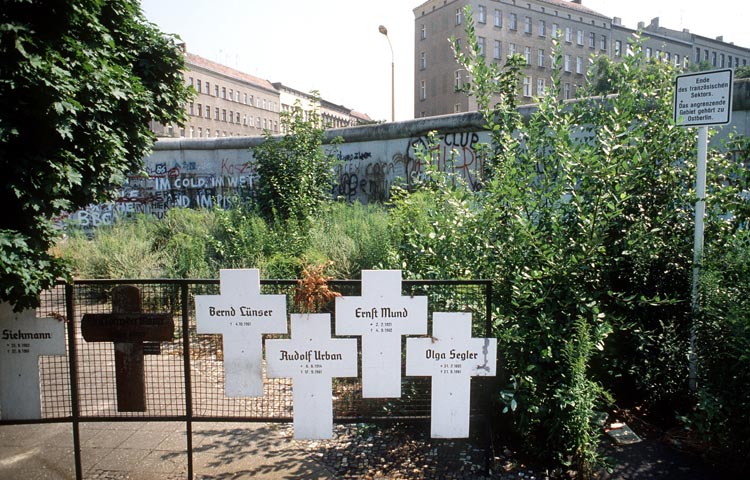
| This is someone who feels personally affected when Stasi terror and repression are mentioned. He is an academic who knows "that one cannot sanction the killings at the Berlin Wall." However, when it comes to the border guards' orders to shoot would-be escapees, he says: "If there is a big sign there, you shouldn't go there. It was completely negligent." |
| This brings up an old question once again: Did a real life exist in the midst of a sham? Downplaying the dictatorship is seen as the price people pay to preserve their self-respect. "People are defending their own lives," writes political scientist Schroeder, describing the tragedy of a divided country. |
 |
| My apologies for the conflicting use of D.D.R. and G.D.R. I have used Deutsche Demokratische Republik, and der Spiegel's English Web pages have relapsed into the Anglicised G.D.R. |
| Happiness really isn't a national trait in some places. |
The
article is available at: |
|
